Why Mesh Radio + ATAK Is a Game-Changer
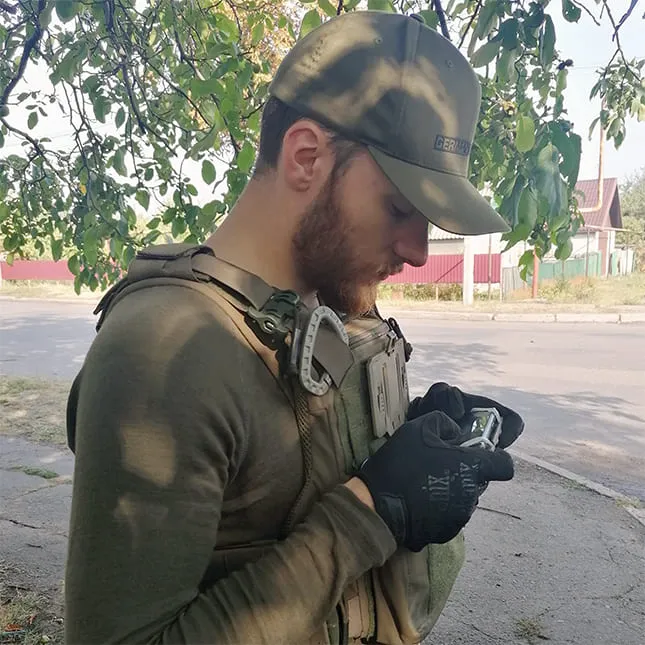
Imagine: Your team is deployed – wildfire, large-scale event, field exercise. No cellular network, no internet, no infrastructure. But everyone on the team can see on their smartphone where the others are. Waypoints are shared, tactical symbols updated, messages delivered – all over a network that the devices build themselves.
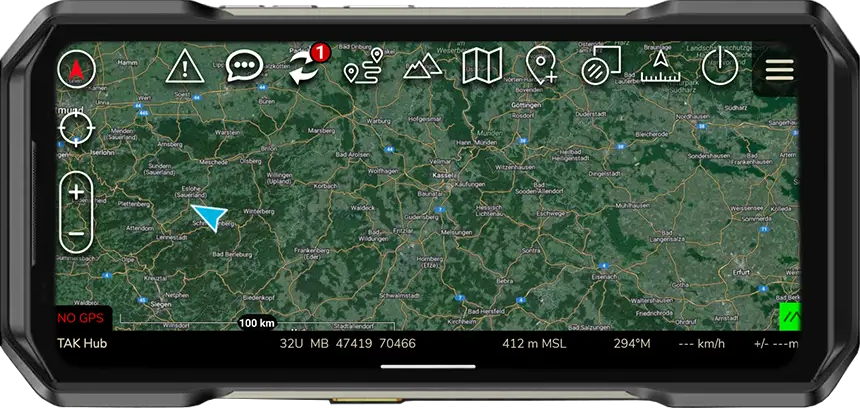
This is the combination of mesh radio and ATAK (Android Team Awareness Kit). Mesh networks relay data through multiple nodes – if one device fails, the message finds another path. ATAK transforms a standard Android smartphone into a full-featured situational awareness tool. Together, they enable digital incident command without any infrastructure.
Sounds promising – and it is. But: The market is confusing. Proprietary systems from the US that cannot legally be operated in Europe. Open-source projects with different strengths and weaknesses. Hardware that looks rugged but doesn’t hold up in the field. And EU frequency regulations that many manufacturers simply ignore.
In this article, we compare the most important mesh radios for ATAK – proprietary and open source, American and European. We explain which devices can be legally operated in the EU, what the differences mean in practice, and which solution fits which use case.
What Is Mesh Networking? – Fundamentals Explained
In a traditional radio network, every device communicates directly with a base station – if it fails, the network is dead. Mesh networking flips this principle: Every device is simultaneously a sender, receiver, and relay. The devices – called nodes – form a self-organizing network among themselves, entirely without central infrastructure.
Multi-Hop: Range Through Teamwork
When Node A wants to send a message to Node D but is outside direct radio range, the message hops through intermediate Nodes B and C – known as multi-hop routing. In practice, 3–4 hops already enable ranges of over 20 kilometers, even with low-power LoRa radio modules.
Store-and-Forward: Resilient Against Failures
When a recipient is temporarily unreachable, intermediate stations store the message and forward it as soon as the recipient reappears on the network. This makes mesh networks extremely resilient – even when individual nodes fail or move.
LoRa: The Radio Technology Behind It
Most mesh devices are based on LoRa (Long Range) – a radio technology designed for maximum range at minimum power consumption. For comparison: Where Wi-Fi achieves hundreds of megabits per second, LoRa operates in the range of a few kilobits. In return, a LoRa signal reaches many kilometers – though primarily with clear line of sight (LoS). A common misconception: Obstacle penetration doesn’t depend on the LoRa modulation but on the frequency. At 868 MHz, penetration through dense vegetation or solid buildings is limited – the signal reflects well in urban environments (MOUT) but penetrates mass less effectively than lower frequencies. In dense forests, LoRa at 868 MHz quickly loses range; elevated repeaters (e.g., via drone or on hilltops) can help.
LoRa offers three key parameters:
- Spreading Factor (SF7–SF12): Higher SF = more range, but slower. Each step roughly doubles the transmission time.
- Bandwidth (125–500 kHz): More bandwidth = faster transmission, but lower sensitivity. In Europe, 125 kHz is standard.
- Coding Rate (4/5–4/8): More redundancy = more robust against interference, but slower.
In practice, mesh systems like Meshtastic use preconfigured presets:
| Preset | Throughput | Range |
|---|---|---|
| SHORT_FAST | approx. 6.8 kbps | 1–3 km |
| LONG_FAST | approx. 1.07 kbps | 5–15 km |
| LONG_MODERATE | approx. 0.34 kbps | 10–30+ km |
Proprietary Mesh Systems: Beartooth, goTenna & Co.
Beartooth MK2
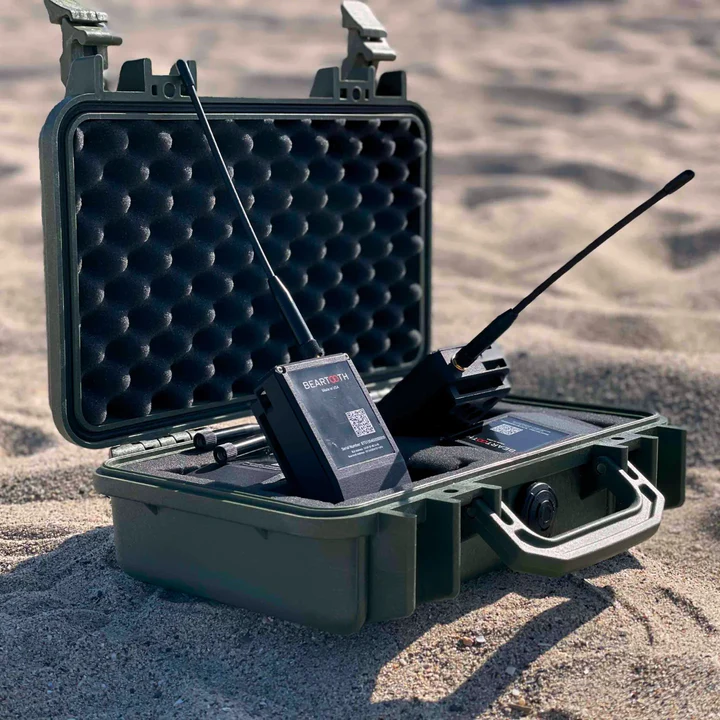
The Beartooth MK2 from the US is one of the best-known commercial mesh radio devices. It connects to the smartphone via Bluetooth and offers push-to-talk voice communication, text messaging, and live location sharing.
Technical Specifications:
- Frequency: 902–928 MHz ISM band with Frequency Hopping (FHSS)
- Transmit power: 1 W (30 dBm)
- Range: up to 20 miles (approx. 32 km) line of sight (manufacturer’s claim under ideal conditions)
- Encryption: AES-256
- Battery: approx. 2 days runtime
- Mesh: Self-Forming/Self-Healing, 100+ nodes, up to 6 hops
- ATAK plugin: available
- Price: from approx. $1,249 (as of February 2026)
Strengths: Polished user interface, out-of-the-box ATAK integration, push-to-talk voice communication (which LoRa-based devices cannot offer), professional support.
goTenna Pro X2 (now Forterra)
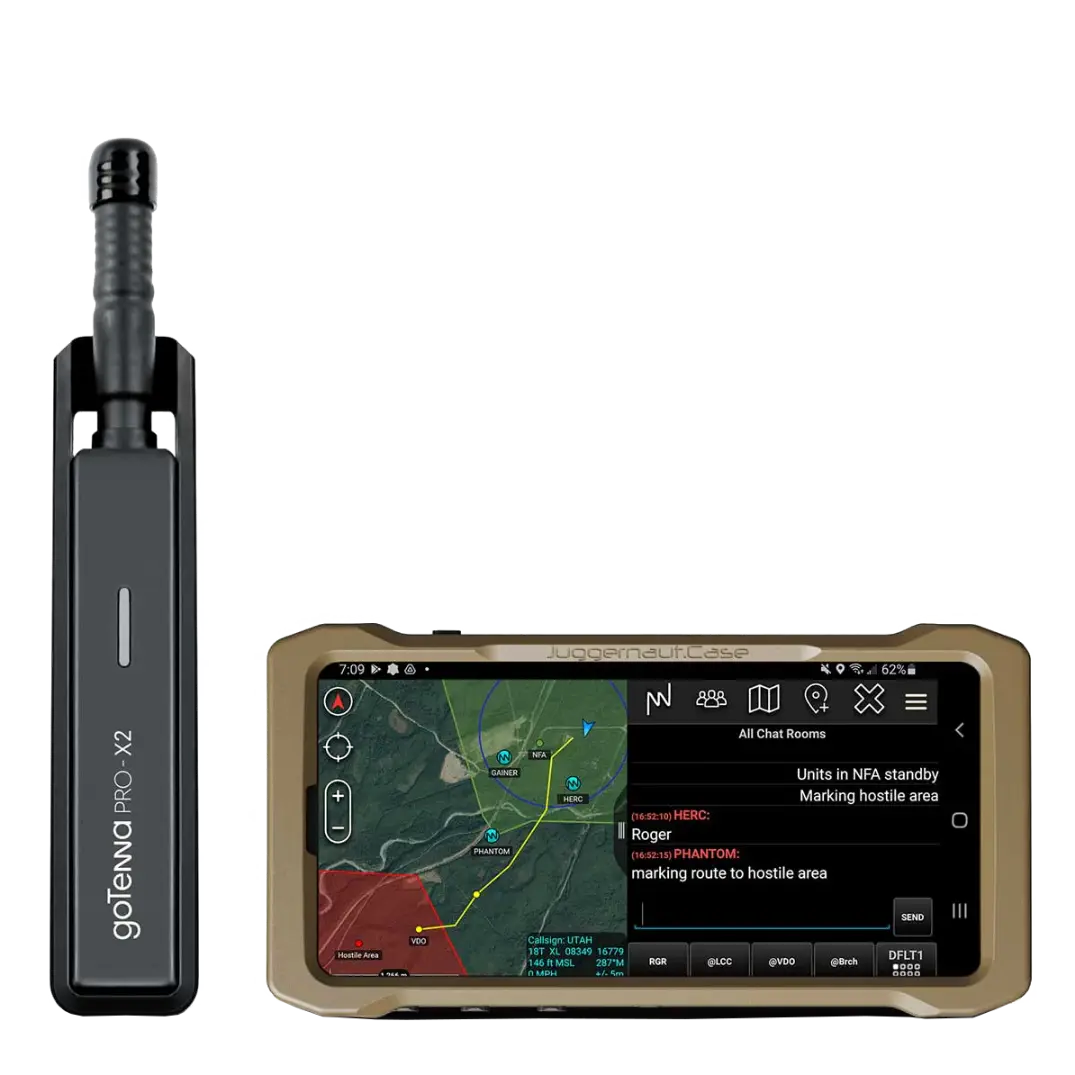
goTenna – now part of Forterra – targets government agencies and military. The Pro X2 operates in the VHF range (142–175 MHz) and offers extreme range through lower frequencies.
Specifications:
- MIL-STD-810 certified
- AES-256, FIPS-compliant
- Tested with 60+ nodes
- Available on request only (Government/Military pricing)
The Fundamental Problem with Proprietary Consumer Systems
Both systems share structural disadvantages: Vendor lock-in (dependency on the manufacturer), high costs, and lack of customizability. If the manufacturer discontinues support – as happens repeatedly in the industry – users are left stranded. For European users, the frequency issue is an additional complication with both devices.
On the plus side, proprietary systems offer a polished user experience: push-to-talk voice (Beartooth), MIL-STD-810 certification (goTenna), and out-of-the-box functionality that open-source solutions cannot match.
Enterprise Class: Doodle Labs Mesh Rider Wearable
Looking at the devices so far, there’s a clear dividing line: LoRa-based systems offer extreme range and energy efficiency, but only kilobit data rates. That’s enough for GPS positions and text messages – but not for video, images, or real-time voice over mesh. This is exactly where the Doodle Labs Mesh Rider Wearable positions itself as an enterprise alternative in an entirely different performance class.
Broadband MANET Instead of LoRa
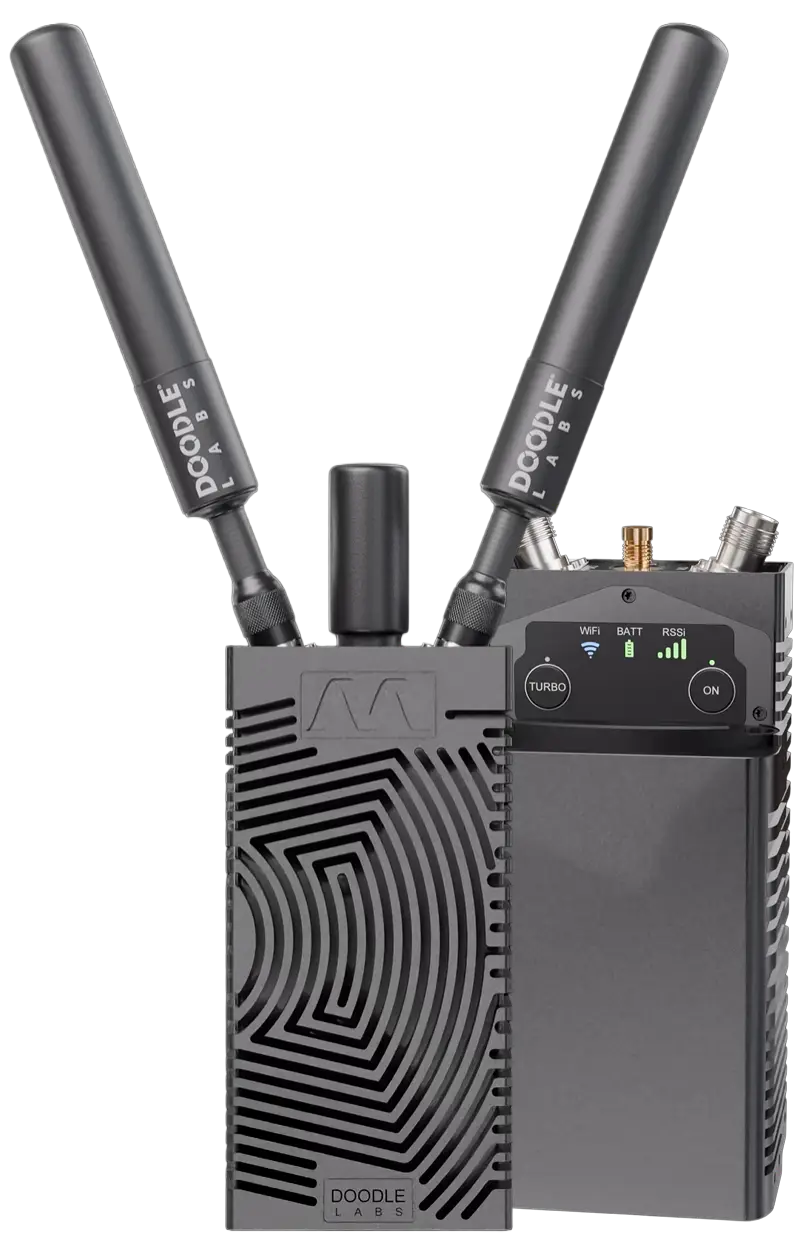
Doodle Labs from Canada doesn’t build LoRa devices. The Mesh Rider uses a proprietary broadband MANET waveform (Mobile Ad-Hoc Network) based on modified Wi-Fi chipsets – with data rates of up to 80 Mbps (new generation: 100 Mbps). That’s a factor of 10,000 compared to typical LoRa transmissions. This enables applications that are unthinkable with LoRa: HD video streaming, real-time drone feeds, Voice-over-IP, and complete TAK data streams including images and files.
- Frequency bands: Multiple variants – S-Band (1625–2500 MHz), C-Band (4400–5920 MHz), L+S Dual-Band, and others. The ISM band variants (2.4 GHz) are generally usable in the EU.
- Range: Up to 2 km HD video streaming ground-to-ground; over 80 km ground-to-air (manufacturer’s claim)
- Throughput: 80 Mbps (current generation), 100 Mbps (new generation)
- Encryption: AES-256, AES-128, FIPS 140-3 Level 1
- Networking: Self-Forming/Self-Healing Mesh, WDS AP, WDS Client, Dynamic Mesh, Multi-Radio Mesh
- TAK integration: Seamless, native connection to CivTAK and Government TAK – no plugin or forwarder required
- Gateway: Integration with cellular (LTE) and satellite connections
- Dimensions: 134 × 63 × 17 mm, 311 g (new generation: 75 g, IP68-rated)
- Battery: 35 Wh (2× 21700 Li-Ion), 8–10 hours; USB-C PD charging
- Antenna connector: TNC (robust, field-ready)
- Channel widths: 3/5/10/15/20 MHz
- Max. transmit power: 1.6 W (32 dBm)
What Makes the Mesh Rider Fundamentally Different
The crucial difference from all other devices in this article: The Doodle Labs Wearable is a full IP network node. Each device creates a local network via its built-in Wi-Fi hotspot, which smartphones, tablets, laptops, or drone controllers can join. ATAK connects via standard UDP multicast – just like over a regular WLAN or a TAK Server. No special plugin, no forwarder, no compression into Protobuf.
This means: Everything that works over a TAK Server also works over Doodle Labs Mesh – including images, files, chat with attachments, and drone video. In practice, a Doodle Labs mesh network replaces the entire IP infrastructure.
New Generation: Multiband and Even More Compact
Doodle Labs has announced a new multiband generation: dual-band models (e.g., 900 MHz + 2.4 GHz) in a single device. The new version is 50% smaller (75 g instead of 311 g), IP68 waterproof with optional nano-coating against salt corrosion, and achieves 100 Mbps. Additionally, it features integrated Mission Critical PTT (Push-to-Talk) via the Zello app.
EU Compliance
Unlike Beartooth and goTenna, Doodle Labs offers EU-compatible frequency variants. The ISM band models (2.4 GHz) and Wi-Fi band models (5 GHz) fall under existing European general authorizations. The S-Band and C-Band variants for defense and government agencies require official frequency allocations – which is standard for the intended user base (military, first responders).
Who Is the Doodle Labs Wearable For?
The Mesh Rider Wearable is not a beginner’s device. It targets organizations that need broadband mesh without infrastructure: special operations forces, large-scale disaster relief, drone operations, and professional security companies. The price is in the mid four-figure range per device (inquire with the manufacturer) – that’s a different budget class than a €35 Meshtastic board. In return, you get a system that makes the leap from “text messages and GPS” to “full digital operational command over mesh.”
Open-Source Mesh: Meshtastic, MeshCore & Co.
Meshtastic – The Community Powerhouse
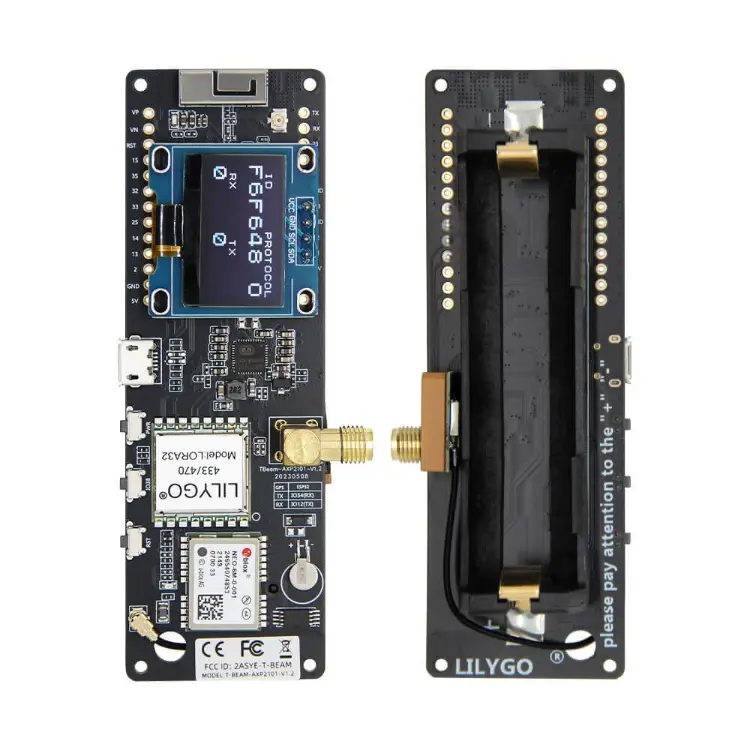
Meshtastic is by far the largest open-source mesh project worldwide. It transforms inexpensive microcontroller boards (ESP32, nRF52) into full-featured mesh nodes – often for under €40 per device.
- Frequency: 868 MHz in the EU (specifically: 869.4–869.65 MHz for maximum transmit power and duty cycle)
- Encryption: AES-256 with pre-shared key
- Configuration: Via Bluetooth or USB through the Meshtastic app (Android/iOS/Web)
- Features: Text messages, GPS telemetry, waypoints, environmental sensors
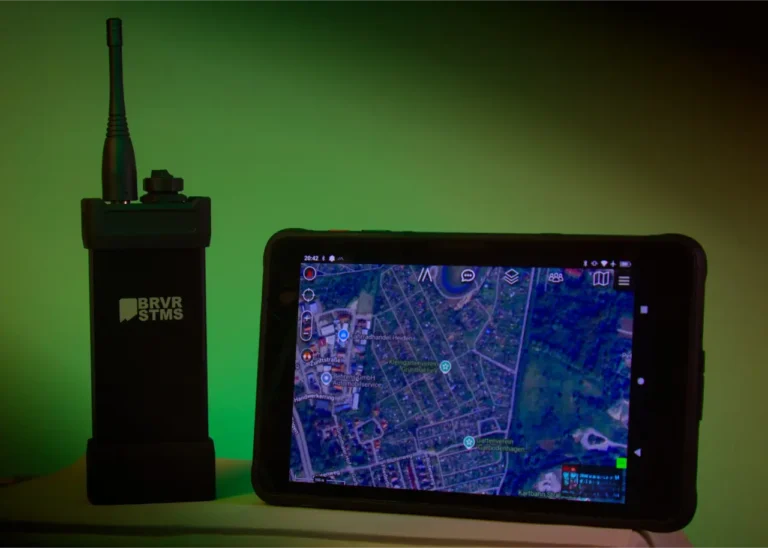
- Hardware: From affordable Heltec V3 modules (approx. €25) to LilyGo T-Beam (approx. €35–60) to professional devices like the Braver Systems LBM
What makes Meshtastic special: The massive community, hardware diversity, and mature ATAK plugin. It is the most thoroughly tested and documented solution for mesh + ATAK.
Limitations: Flooding-based routing can lead to collisions in large networks (20+ nodes). Bandwidth is LoRa-limited – no voice or video transmission. And: The AES-256 encryption is based on pre-shared keys – anyone with the key can listen in.
MeshCore – The Lean Alternative
MeshCore is a C++ alternative to Meshtastic that has been growing since 2025, developed with the goal of being more efficient and faster.
Key difference: Instead of pure flooding, MeshCore uses hybrid routing – it builds routing information and forwards messages more selectively. This reduces network overhead and improves performance, especially in larger networks.
- Lightweight codebase (pure C++)
- Runs on the same hardware as Meshtastic (ESP32, nRF52)
- Still smaller community, but growing
- Currently no ATAK plugin available – integration is under development
MeshCore and Meshtastic don’t necessarily compete – they serve different needs. Meshtastic is the more accessible ecosystem with ATAK integration, MeshCore the more technically efficient solution for developers.
OpenMANET – Wi-Fi HaLow Instead of LoRa
OpenMANET takes a fundamentally different approach: Instead of LoRa, it uses Wi-Fi HaLow (IEEE 802.11ah) with Morse Micro chipsets on a Raspberry Pi platform.
The advantage: Significantly higher bandwidth than LoRa – enough for IP-based communication, file transfer, and even compressed voice. ATAK can connect via standard UDP multicast without special plugins.
The trade-off: Higher bandwidth comes at the cost of range and energy efficiency. Typical range is 1–5 km. The hardware is less widely available and the project is still in an early stage.
Reticulum – The Fundamental Approach
Also worth mentioning is Reticulum – a networking stack that has been in development for over 15 years, designed for resilient communication. Unlike Meshtastic, Reticulum is transport-agnostic: It can use LoRa, Packet Radio, TCP/IP, and Wi-Fi HaLow simultaneously and intelligently switch between media. With true end-to-end encryption (not just PSK) and apps like Sideband or NomadNet.
Limitation: Reticulum currently has no ATAK integration, making it less relevant for the focus of this article.
EU Regulation: The 868 MHz Problem
Europe’s Narrow Playing Field
In the US, LoRa-based mesh devices have access to the ISM band from 902 to 928 MHz – a generous 26 MHz of bandwidth. In Europe, the situation is vastly different. European frequency regulation (EU Decision 2006/771/EC, ETSI EN 300 220) allocates only a narrow, heavily fragmented spectrum around 868 MHz for the ISM band:
| Sub-Band | Frequency Range | Duty Cycle | Max. Transmit Power |
|---|---|---|---|
| K | 863–865 MHz | 0.1% | 25 mW |
| L | 865–868 MHz | 1% | 25 mW |
| M | 868–868.6 MHz | 1% | 25 mW |
| N | 868.7–869.2 MHz | 0.1% | 25 mW |
| P ✓ | 869.4–869.65 MHz | 10% | 500 mW |
| Q | 869.7–870 MHz | 1% | 25 mW |
250 Kilohertz vs. 26 Megahertz
For mesh systems like Meshtastic, in practice only Sub-Band P is truly usable – it is the only one that offers both adequate transmit power (500 mW) and a 10% duty cycle that enables bidirectional communication.
That’s 250 kHz of usable spectrum – compared to 26,000 kHz in the US. A factor of 104. The consequences:
- Fewer simultaneous channels – where US users can operate dozens of channels in parallel, European users share a narrow segment
- Duty cycle pauses – even in the best Sub-Band P, a device may only transmit 10% of the time
- Lower effective data rate – after accounting for duty cycle restrictions, the real throughput drops even further
Why US Devices Don’t Work in the EU
Beartooth MK2 (915 MHz): In Europe, 915 MHz falls outside any license-free allocation – it’s reserved for GSM cellular and railway communications. Operation = illegal radio transmission, subject to fines under the Telecommunications Act (Telekommunikationsgesetz, TKG).
goTenna Pro X2 (VHF): The frequencies 142–175 MHz require an official frequency allocation or amateur radio license in the EU. Since amateur radio prohibits encrypted transmission and goTenna uses AES-256, this path is also blocked for most users.
What This Means for Manufacturers and Users
- Hardware must be designed for 868 MHz (different RF filters, antennas, PA stages compared to 915 MHz)
- CE marking under the Radio Equipment Directive (RED 2014/53/EU) is mandatory
- Firmware must reliably enforce the duty cycle
- Protocol efficiency is even more important in Europe than in the US – every transmitted byte counts
- A simple “US-to-EU port” via firmware update is not possible – it requires a hardware redesign
Note: This article is for informational purposes and does not constitute legal advice. For specific deployments, please contact the Federal Network Agency (Bundesnetzagentur, BNetzA).
Hardware Comparison: EU-Compliant Mesh Devices
Expeditus Systems – Crow & Rook
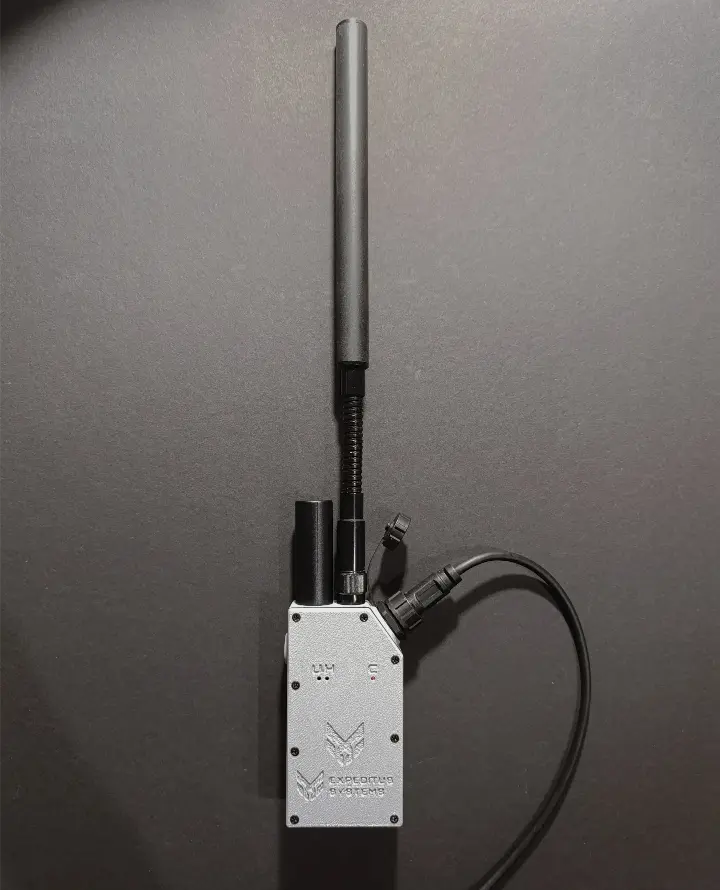
Expeditus Systems is a European manufacturer specializing in ready-made Meshtastic devices with high-quality 3D-printed enclosures.
Crow – The Flagship
- Meshtastic firmware on ESP32/nRF52 platform
- 868 MHz (EU-compliant)
- Enclosure made of PA12 Nylon (3D-printed) – impact-resistant, lightweight, professional appearance
- AES-256 encryption
- ATAK integration via Meshtastic ATAK Forwarder Plugin
- Range: typically 5–15 km, up to 40+ km under optimal conditions
Rook – The Budget Option
Same Meshtastic base and EU compliance, more compact form factor, lower price.
Braver Systems LBM – Professional Mesh Hardware from Sweden
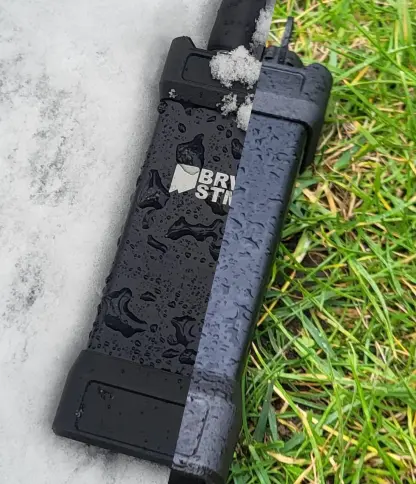
Braver Systems sets the professional standard for EU-compliant mesh radio devices. The LBM (Low Bandwidth MANET) is designed for demanding use by first responders, military, and professional teams – and is a partner of TAK Hub.
- 868 MHz ISM band (EU-compliant)
- Meshtastic and MeshCore compatible (open source)
- Enclosure: 1.5 mm black anodized aluminum with custom PA12 end caps
- Antenna connector: TNC Female – swappable antennas (omnidirectional or higher gain)
- Charging: USB-C
- Water and shock resistant (aluminum construction with sacrificial horns that absorb impacts)
- AES-256 encryption
- Operation: A single rotary switch. Turn all the way up = On, one step back = RF Silence mode.
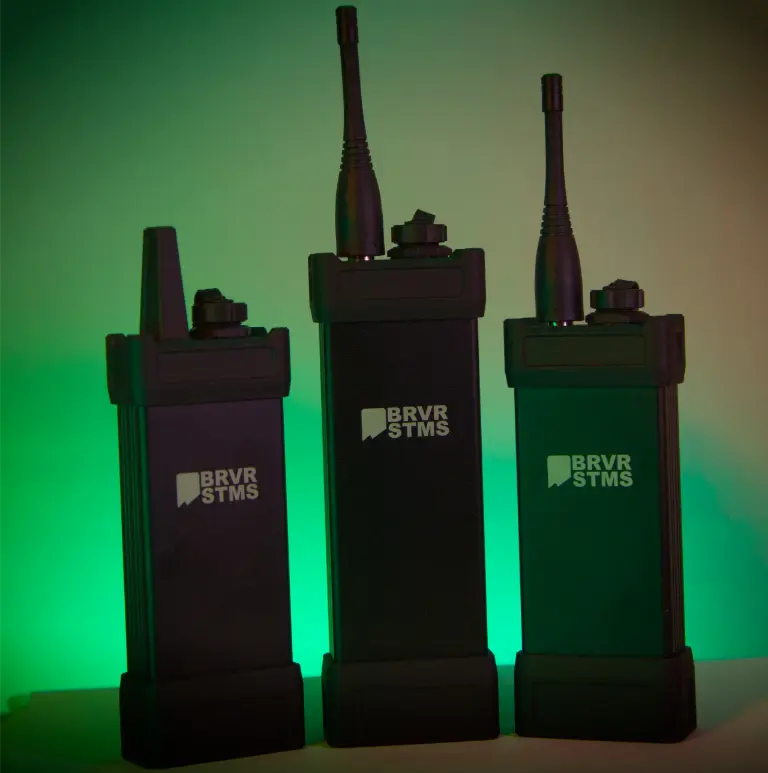
Three Variants
| Variant | Description |
|---|---|
| LBMK | Built-in antenna, protected by PA11 end cap – ideal when snagging is a risk |
| LBM | External antenna with TNC connector – the all-rounder |
| LBME | TNC connector + larger battery – for extended deployments |
What makes the TNC connector special: Unlike the SMA connector common in hobby electronics (small, fragile), TNC is significantly more robust. It withstands mechanical stress and can be operated securely even while wearing gloves. Braver Systems antennas are designed so that under force, the antenna breaks – not the radio.
Additionally, Braver Systems offers custom camo wraps – laser-cut wraps made from milspec material in any camouflage pattern or color: Multicam, EMS yellow, fire department red, police blue.
Comparison Table: All Devices at a Glance
| Feature | Beartooth MK2 | goTenna Pro X2 | Doodle Labs Wearable | Expeditus Crow | Expeditus Rook | Braver Systems LBM |
|---|---|---|---|---|---|---|
| Price Range | approx. $1,249 | approx. $1,000 | Enterprise (mid 4-figures) | Hobby (approx. €220) | Budget (approx. €100) | Professional (mid 3-figures) |
| Technology | LoRa (FHSS) | LoRa (VHF) | Broadband MANET | LoRa | LoRa | LoRa |
| Frequency | 902–928 MHz | 142–175 MHz | Multi-Band | 868 MHz | 868 MHz | 868 MHz |
| EU-Compliant | ✗ No | ⚠ Only with authorization | ✓ Yes (ISM variants, max. 100mW) | ✓ Yes | ✓ Yes | ✓ Yes |
| Throughput | LoRa-typical | LoRa-typical | 80–100 Mbps | LoRa-typical | LoRa-typical | LoRa-typical |
| Range (LoS) | up to 32 km | up to 160+ km | 2 km Video / 80+ km Air | 5–40+ km | 5–40+ km | 5–40+ km |
| Enclosure | Plastic | MIL-STD-810 | IP68, 311g (75g new) | PA12 Nylon (3D) | PA12 Nylon (compact) | 1.5 mm Alu + PA12 |
| ATAK | Native plugin | Native plugin | Native (full IP) | Via Forwarder | Via Forwarder | Via Forwarder |
| Encryption | AES-256 | AES-256 (FIPS) | AES-256 (FIPS 140-3) | AES-256 (PSK) | AES-256 (PSK) | AES-256 (PSK) |
| Voice/Video | Push-to-Talk | Yes | VoIP + HD Video | No | No | No |
| Firmware | Proprietary | Proprietary | Proprietary | Open Source | Open Source | Open Source |
| Target Audience | US Agencies | Military/Gov. | Enterprise, SOF | Hobby, Outdoor | Beginners | First Responders, Military, Professionals |
Ranges are manufacturer specifications under ideal conditions. Actual range depends heavily on terrain, vegetation, and antenna.
Mesh Radio + ATAK in Practice
How the Integration Works
The link between Meshtastic and ATAK is the ATAK Forwarder Plugin. The data flow:
- ATAK generates a CoT event (Cursor on Target) – e.g., its own position
- The plugin compresses it into the bandwidth-optimized Protobuf format (TAK Protocol v1)
- Via the AIDL interface, it is passed to the Meshtastic Android app
- The app sends it via Bluetooth to the Meshtastic device
- The device transmits it via LoRa into the mesh – through any number of hops
- On the receiving end, the reverse process takes place
What is transmitted: Positions (Blueforce Tracking), chat messages, waypoints, tactical symbols.
What doesn’t work: Images, video, voice – LoRa is too narrowband for that.
Realistic Capacities
| Preset | Practical Team Size | PLI Interval |
|---|---|---|
| SHORT_FAST | 10–15 nodes | 30 sec. |
| LONG_FAST | 8–12 nodes | 120 sec. |
| LONG_MODERATE | 4–8 nodes | 300 sec. |
TAK Server vs. Mesh – Or Both?
A TAK Server over the internet provides full bandwidth (images, video, hundreds of users) but requires infrastructure. Mesh radio works without anything but is limited to text and GPS.
Use Cases
- Disaster relief: Cellular network destroyed, Federal Agency for Technical Relief (THW) and fire department deploy – mesh provides Blueforce Tracking without a single cell tower
- Outdoor events: Trail run, mountain rescue, course marshals – everyone sees each other on the map, even in dead zones
- First responder operations: Mesh as a second layer alongside TETRA/emergency radio – automatic tracking offloads the voice radio channel
- Training & airsoft: Real-time common operating picture at a fraction of the cost of professional systems
- Military: Minimal transmit power and short burst transmissions for limited-radio scenarios. Important: LoRa signals are detectable with appropriate equipment – this is not covert communication but a low-power alternative.
Conclusion: Which System Fits Your Mission?
For enterprise and high performance (military, SOF, major incidents): The Doodle Labs Mesh Rider Wearable is in a league of its own. 80–100 Mbps broadband MANET, HD video over mesh, native TAK integration without plugin detours, FIPS 140-3 encryption. If you need full digital operational command without infrastructure – including video, drone feeds, and VoIP – there’s no getting around Doodle Labs. The price is enterprise, but so is the capability.
For professional users (first responders, military, security): The combination of Braver Systems LBM and Meshtastic offers the best overall package in Europe for LoRa-based mesh communication. Rugged aluminum enclosure, swappable TNC antenna, EU-compliant, AES-256, and full ATAK integration. Ideal when positions and text messages are sufficient and every euro counts.
For hobby, training, and airsoft: The Expeditus Crow and Rook deliver excellent value for money. High-quality enclosures, EU-compliant, Meshtastic-based – ideal for getting started.
Proprietary consumer systems (Beartooth, goTenna): Polished user experience, but problematic for the European market. Beartooth (915 MHz) is not permitted in the EU, goTenna requires official frequency allocations.
Open source as a foundation: Meshtastic is the market leader with the best ATAK integration. MeshCore is the more technically efficient alternative for developers but doesn’t yet have an ATAK plugin. OpenMANET fills the bandwidth gap for more demanding scenarios.
TAK Hub – Your Partner for Mesh & ATAK
At TAK Hub, we have been deeply immersed in ATAK and mesh communication for years – not just in theory, but in real-world deployments. Our expertise comes from actual projects with first responder organizations, security companies, and international partners.
We support you every step of the way: Consult · Deploy · Train · Develop · Support
Planning to deploy mesh radio with ATAK? Get in touch – we’ll advise you with no obligation and find the best solution together.